Format Factory Version History: Full Changelog
The milestones that actually matter, pulled from the developer's own changelog — not every point release, just the ones that changed what the app can do or which systems it runs on.
Current version: 5.22.0.0
March 2026Updated the bundled Python runtime to 3.12, added a CAJ-to-PDF module, added Markdown as a document export format, and added video export to the m3u8 streaming format.
Version-by-version changelog
v5.22.0
March 2026Current release. Python runtime updated to 3.12, added a CAJ-to-PDF module, added Markdown as a document export format, and added video export to the m3u8 streaming format.
v5.21.0
April 2025The built-in video-downloader module switched to the yt-dlp engine, replacing the previous downloader.
v5.20.0
November 2024Encoding engine updated to FFmpeg 7.1. Added the VVC (H.266) encoder for MP4/MKV, and HEVC/VP9/AV1 support for FLV.
v5.8.1
August 2021Explicit compatibility fix for Windows 11, which had launched with real, documented issues on earlier builds.
v5.5.0
2021The Delogo watermark-removal tool gained support for selecting multiple areas at once, useful for source clips with more than one overlay to clean up.
v5.1.0
2020Added PDF compression, encryption, and decryption to the Document toolset.
v5.0.0
February 2020Migrated to 64-bit only, dropping 32-bit Windows support. The last 32-bit-compatible release is the earlier v4.10.5.0.
v4.9.0
September 2019Added the PDF Joiner and Video Downloader tools.
v4.40
September 2018Dropped support for Windows XP.
v1.00
March 2008The first release the developer considers "official," following an initial v0.00 build in October 2007.
Get the current version, 5.22.0.0
~163 MB, 64-bit Windows only, published by Free Time Software Technology Co., Ltd.. Go to the download page for the official link, the exact byte size to check it against, and a safe-download checklist.
Only 64-bit Windows 7 / 8 / 10 / 11 are supported.
How hardware acceleration support evolved
Beyond the format-level milestones above, the encoding engine's hardware support has grown steadily release over release: Intel Quick Sync Video (QSV) support arrived in 2018, NVIDIA's H.264/H.265 hardware encoding followed the same year, and AMD hardware acceleration was added in 2020, alongside an NVIDIA SDK update. The 2024 jump to FFmpeg 7.1 brought the most recent refresh across all three vendors' acceleration paths at once. This progression is why the built-in HA Test tool matters more on an older install — a build from several years ago may simply predate support for your current GPU.
How to check your installed version
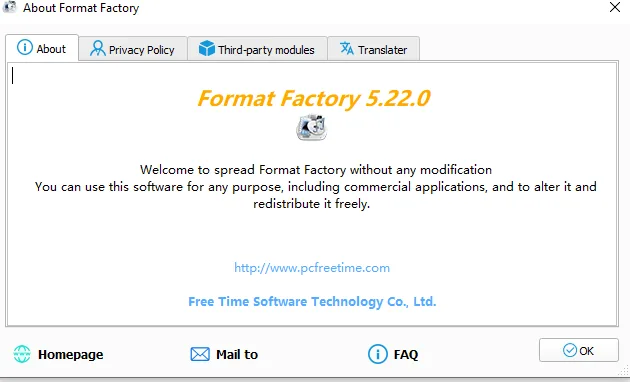
Open Format Factory and check the title bar — it displays the exact build, e.g. “FormatFactory X64 5.22.0.0”, confirmed directly on our own test install. The Help menu's “About” dialog shows the same version number alongside the developer's licensing text.
More version history questions
How often does Format Factory get updated?
Based on the milestones above, releases have historically landed anywhere from a few months to roughly a year apart, with smaller point releases in between the major milestones we've listed here. It's an actively maintained project rather than one that's gone stale.
Does Format Factory update itself automatically?
The Options screen includes a "check for updates" setting, confirmed in our own installation. We didn't specifically test whether it downloads and installs updates silently or just notifies you — check that setting directly if automatic updating matters to your workflow.
Is it worth updating from an older version?
Generally yes — recent releases have added real functionality (new export formats, an updated FFmpeg encoding engine, the Windows 11 fix) rather than just cosmetic changes. The one exception is if you specifically need 32-bit support, in which case staying on the older v4.10.5.0 line is a deliberate choice, not something to update away from.
Where to find the developer's own changelog
We pulled every milestone on this page from the developer's own published changelog, reviewed in full from the earliest entries through the current release. If you want the complete, unabridged list — including minor point releases we didn't include here because they didn't change functionality in a way worth a dedicated entry — the developer's official site publishes the full version-by-version history directly.
The short version
Format Factory has shipped continuously since an initial 2007 build, through the first “official” v1.00 in 2008, the 64-bit-only switch in 2020, the Windows 11 compatibility fix in 2021, and up through the current 5.22.0.0 release with its Python 3.12 update and new CAJ-to-PDF and Markdown export tools. That's close to two decades of active maintenance, not a project that appeared recently or has since gone quiet.
If you're trying to decide whether to trust a freeware tool with a long history versus a newer, unproven one, this changelog itself is part of the evidence worth weighing — a consistent, documented release cadence over many years is a meaningfully different signal than a project with no visible track record.
We'll keep this page current
As new versions ship, we'll add them to this page the same way we built it — reviewed against the developer's own changelog, not copied secondhand from a mirror site that may cache outdated release dates or version numbers.
The practical takeaway
Run the current 5.22.0.0 release unless you specifically need 32-bit support, in which case the older v4.10.5.0 is the deliberate, documented exception rather than a version to avoid out of caution.
What might come next
We won't speculate on unannounced features, but the pattern across recent releases — new export formats, engine upgrades, and hardware-acceleration improvements roughly once or twice a year — suggests the project is likely to keep expanding its document and codec support rather than settling into pure maintenance mode.